Cloud storage options, such as Amazon S3, Google Cloud Storage, Azure, Backblaze B2, etc, are ideal for backup purpose.
For example, for Amazon S3, the upload is free. You only pay for the storage. So you have the benefit of:
- Extremely fast access to local SeaweedFS Filer
- Near-Real-Time Backup to Amazon S3 with zero-cost upload network traffic.
Architecture (Deprecated by Async-Backup)
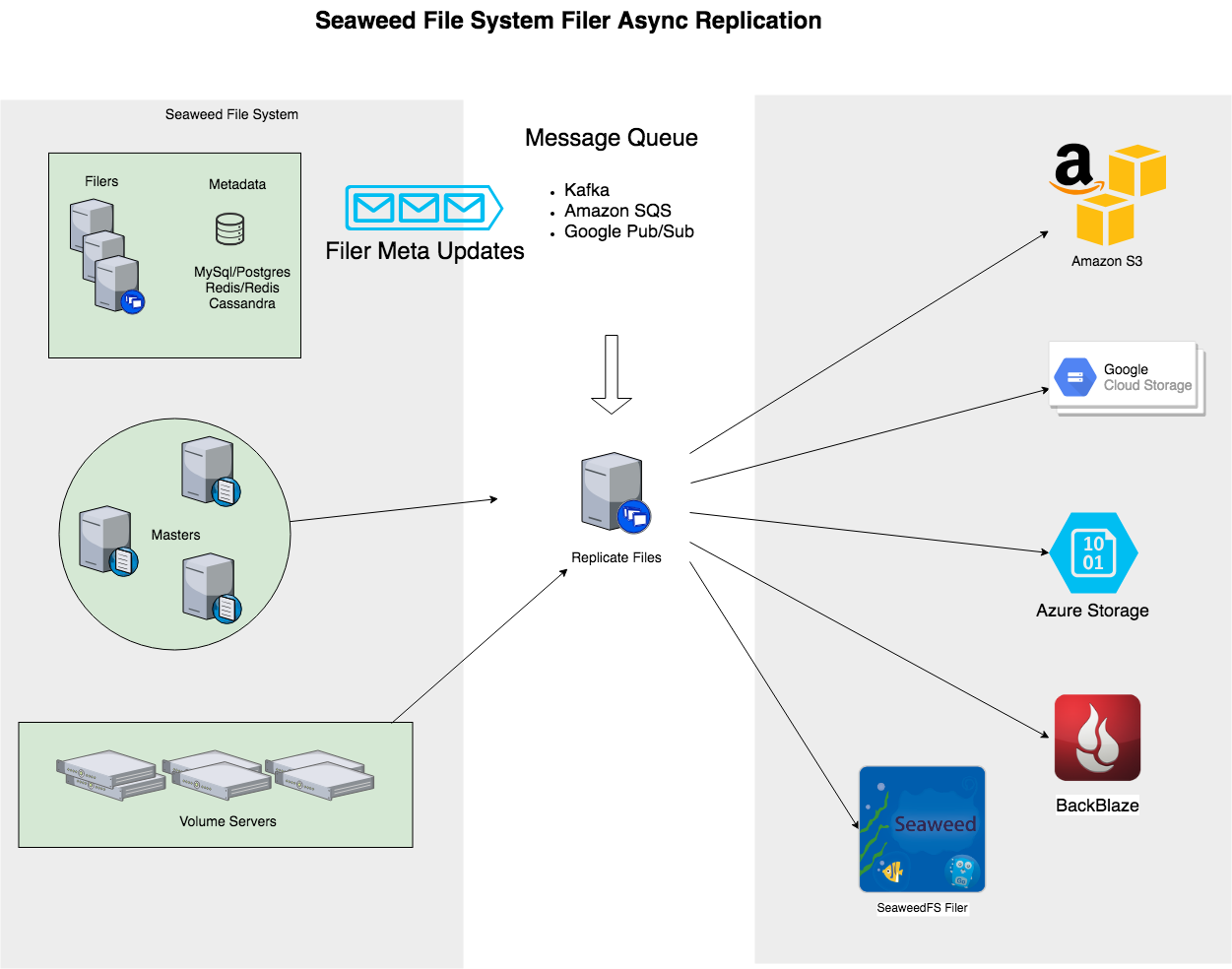
Every file changes in Filer will trigger a notification sent to a message queue. A "weed replicate" process will read from the message queue, read the actual file content, and send the update to the cloud sink.
- Message Queue can be: Kafka, AWS SQS, Google Cloud Platform Pub/Sub.
- Cloud Sink can be: AWS S3, Google Cloud Storage, Microsoft Azure, Backblaze B2.
Configuration
- Configure notification. use "
weed scaffold -config=notification" to see the notification section.
[notification.kafka]
enabled = true
hosts = [
"localhost:9092"
]
topic = "seaweedfs_filer_to_s3"
-
Setup Kafka. Possibly you need to create the Kafka topic if auto topic creation is not enabled.
-
Configure replication. use "
weed scaffold -config=replication" to see the notification section.
[source.filer]
enabled = true
grpcAddress = "localhost:18888"
directory = "/buckets" # all files under this directory tree are replicated
[sink.s3]
# read credentials doc at https://docs.aws.amazon.com/sdk-for-go/v1/developer-guide/sessions.html
# default loads credentials from the shared credentials file (~/.aws/credentials).
enabled = false
aws_access_key_id = "" # if empty, loads from the shared credentials file (~/.aws/credentials).
aws_secret_access_key = "" # if empty, loads from the shared credentials file (~/.aws/credentials).
region = "us-west-1"
bucket = "your_bucket_name" # an existing bucket
directory = "/" # destination directory
- Start the Kafka.
- Start the replication. "
weed filer.replicate" - Start the filer. "
weed filer"
Server-Side Encryption (SSE)
weed filer.replicate transparently decrypts SSE-S3 and SSE-KMS encrypted objects before uploading to cloud sinks. SSE-C objects cannot be decrypted (customer key unavailable) and will produce an error. See Server-Side Encryption — Replication and Backup for details.
Replicate existing files
See Async-Replication-to-another-Filer#replicate-existing-files
Introduction
- Quick Start with weed mini
- Simplest S3 Bucket and User Setup
- Components
- Getting Started
- Production Setup
- A typical step‐by‐step example
- Benchmarks
- FAQ
- Applications
API
Configuration
- Replication
- Store file with a Time To Live
- Failover Master Server
- Erasure coding for warm storage
- EC Bitrot Detection
- Server Startup via Systemd
- Environment Variables
Filer
- Filer Setup
- Directories and Files
- File Operations Quick Reference
- Data Structure for Large Files
- Filer Data Encryption
- Filer Commands and Operations
- Filer JWT Use
- TUS Resumable Uploads
Filer Stores
- Filer Cassandra Setup
- Filer Redis Setup
- Super Large Directories
- Path-Specific Filer Store
- Choosing a Filer Store
- Customize Filer Store
Management
Advanced Filer Configurations
- Migrate to Filer Store
- Add New Filer Store
- Filer Store Replication
- Filer Active Active cross cluster continuous synchronization
- Filer as a Key-Large-Value Store
- Path Specific Configuration
- Filer Change Data Capture
- Filer Operation Serialization
FUSE Mount
- FIO benchmark
- fstab and systemd mount
- POSIX Compliance
- Distributed POSIX Locks
- P2P reading in weed mount
WebDAV
SFTP Server
Cloud Drive
- Cloud Drive Benefits
- Cloud Drive Architecture
- Configure Remote Storage
- Mount Remote Storage
- Cache Remote Storage
- Cloud Drive Quick Setup
- Gateway to Remote Object Storage
AWS S3 API
- Amazon S3 API
- Supported APIs vs Minio
- S3 Lifecycle
- S3 Lifecycle vs Volume TTL
- S3 Conditional Operations
- S3 CORS
- S3 Object Lock and Retention
- S3 Object Versioning
- S3 API Benchmark
- S3 API FAQ
- S3 Bucket Quota
- S3 Rate Limiting
- S3 API Audit log
- S3 Nginx Proxy
- Docker Compose for S3
S3 Table Bucket
- S3 Table Bucket
- S3 Table Bucket Commands
- S3 Tables Security
- SeaweedFS Iceberg Catalog
- Iceberg Table Maintenance
Iceberg Integrations
- Spark Iceberg Integration
- Trino Iceberg Integration
- Dremio Iceberg Integration
- DuckDB Iceberg Integration
- Doris Iceberg Integration
- RisingWave Iceberg Integration
- Lakekeeper Iceberg Integration
S3 Authentication & IAM
- S3 Configuration - Start Here
- S3 Credentials (
-s3.config) - OIDC Integration (
-s3.iam.config) - Kubernetes ServiceAccount Authentication (IRSA-style)
- S3 Policy Variables
- S3 Policy Conditions
- S3 Bucket Policies
- Amazon IAM API
- AWS IAM CLI
- weed shell - Shell IAM Commands
Server-Side Encryption
S3 Client Tools
- AWS CLI with SeaweedFS
- s3cmd with SeaweedFS
- rclone with SeaweedFS
- restic with SeaweedFS
- nodejs with Seaweed S3
Machine Learning
HDFS
- Hadoop Compatible File System
- run Spark on SeaweedFS
- run HBase on SeaweedFS
- run Presto on SeaweedFS
- Hadoop Benchmark
- HDFS via S3 connector
Replication and Backup
- Async Replication to another Filer [Deprecated]
- Async Backup
- Async Filer Metadata Backup
- Async Replication to Cloud [Deprecated]
- Kubernetes Backups and Recovery with K8up
Metadata Change Events
Messaging
- Structured Data Lake with SMQ and SQL
- Seaweed Message Queue
- SQL Queries on Message Queue
- SQL Quick Reference
- PostgreSQL-compatible Server weed db
- Pub-Sub to SMQ to SQL
- Kafka to Kafka Gateway to SMQ to SQL
Use Cases
Operations
- System Metrics
- weed shell
- Data Backup
- Deployment to Kubernetes and Minikube
- Deployment with seaweed-up
Rust Volume Server
Advanced
- Large File Handling
- Optimization
- Optimization for Many Small Buckets
- Volume Management
- Tiered Storage
- Cloud Tier
- Cloud Monitoring
- Load Command Line Options from a file
- SRV Service Discovery
- Volume Files Structure
Security
- Security Overview
- Security Configuration
- Cryptography and FIPS Compliance
- Run Blob Storage on Public Internet
